Why do San Carlos hillside soils break sewer lines?
The hills of San Carlos (such as Devonshire and Howard Park) contain expansive adobe clay. During wet winter months, the clay absorbs water and expands outward; in dry summers, it dehydrates and shrinks. This cyclic soil movement causes differential ground settling, which easily snaps rigid, brittle vitrified clay sewer pipes or dislodges bell-and-spigot joints, creating entry points for tree roots.
Why does my San Carlos home need a Pressure Reducing Valve (PRV)?
Because of the steep elevation differences between municipal hillside water reservoirs and lower residential streets, municipal water pressure often reaches 100 to 130+ PSI . High water pressure stresses water heater tanks, causes toilet fill valves to hiss and leak, and can burst washing machine hoses. California Plumbing Code requires incoming water pressure to be regulated to 80 PSI or lower (ideally 55–65 PSI) using an approved PRV.
What are the benefits of trenchless pipe bursting vs open digging?
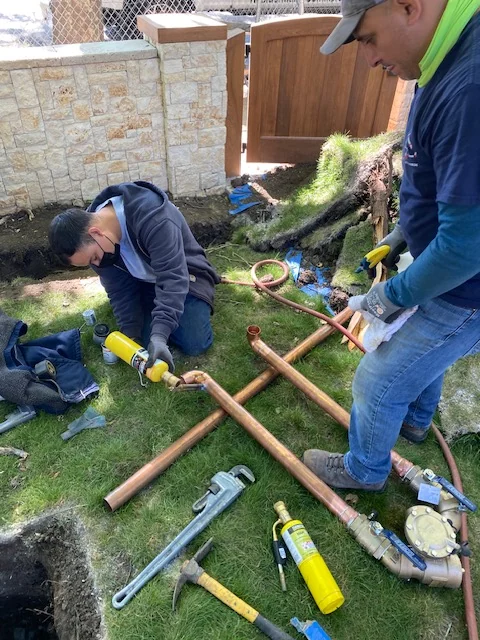
Traditional sewer excavation requires digging a deep trench through your driveway, lawn, and landscaping. Trenchless pipe bursting requires only two small excavation pits. A hydraulic pulling machine fractures the damaged clay pipe outward while immediately pulling a brand new seamless High-Density Polyethylene (HDPE) pipe into place. The seamless HDPE pipe has no joints, completely eliminating future tree root intrusion.
Do you handle permits with the City of San Carlos Building Division?
Yes. Daso Plumbing is fully licensed and insured in California. We prepare engineering drawings, pull all required permits from the City of San Carlos Building Division, and coordinate directly with municipal plumbing inspectors for final sign-off.